
Vienna, AT
Projects

Building Flex.Insight, beating enshittification

image
May 1, 2025
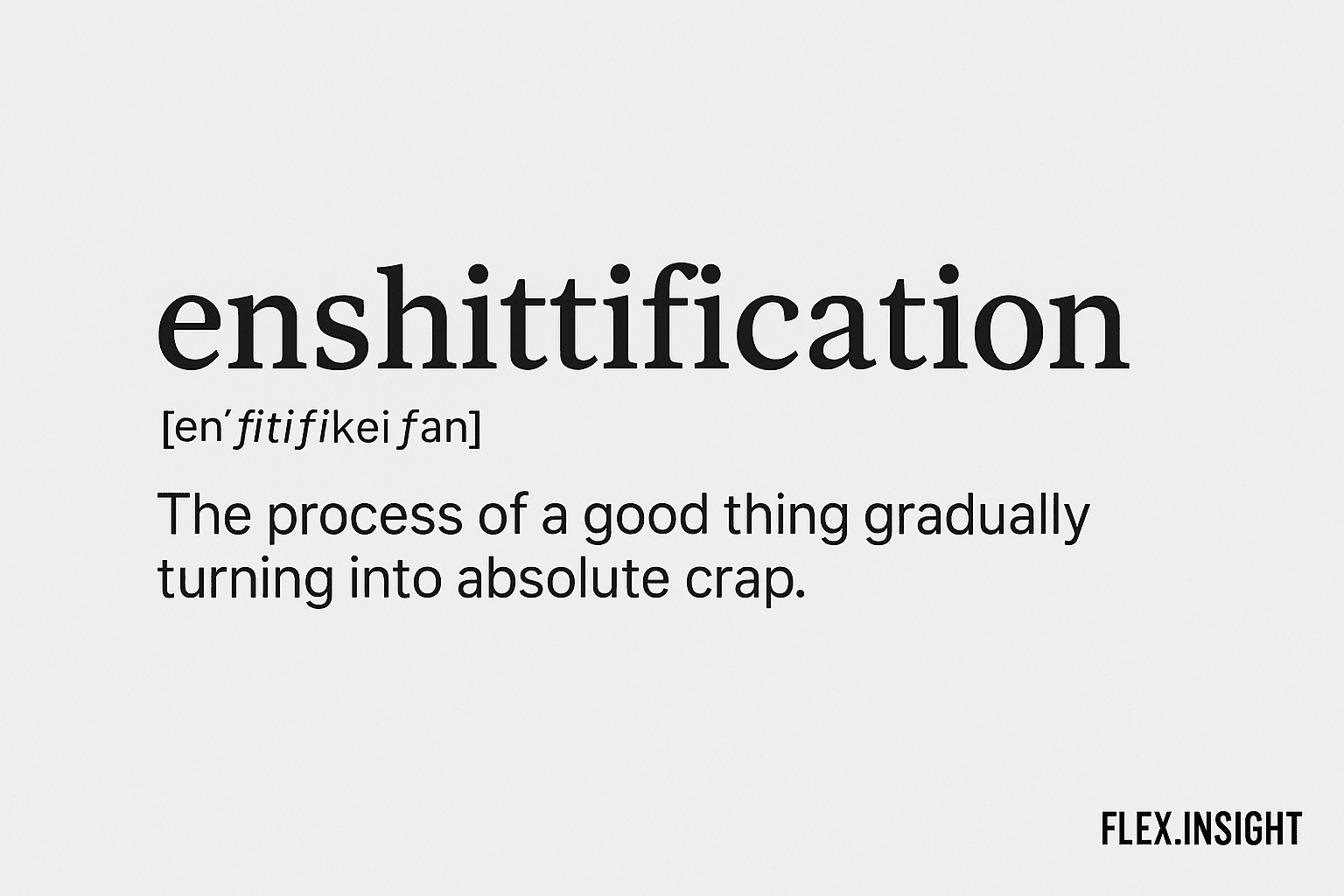
Last month at CloudFest, I found myself at dinner with two legends of the internet: Cory Doctorow and Roger Dingledine. Cory had just given a talk on what he cheekily calls “enshittification” – a term that captures how online platforms start great and then gradually turn to, well, garbage as they chase profits. Over dinner and geeky conversation, Cory expanded on how tech monopolies lure us in with useful services, only to degrade the user experience in pursuit of revenue. “Here’s how platforms die,” he explained. “First, they’re good to their users; then they abuse those users to make things better for their business customers; finally, they abuse those business customers to claw back all the value for themselves. Then, they die.” In other words, once a company has us and its partners hooked, it starts squeezing everyone – a vicious cycle of decline that he sums up with that unprintable word. Meanwhile, on my other side at the table was Roger Dingledine (co-founder of the Tor Project), who shared his own war stories of fighting for internet privacy and freedom. Roger spoke passionately about how privacy and anonymity are essential to a free, open web. Both Cory and Roger have devoted their careers to not accepting the status quo. Needless to say, I left that dinner inspired (and frankly, a bit star-struck). I also left with my mind buzzing: if enshittification is how big tech platforms decay, isn’t a similar rot happening in our workplaces and industries? Doctorow’s concept of enshittification might be rooted in Silicon Valley, but the underlying pattern – start good, get greedy, ruin everything – shows up far beyond our apps. In fact, I’d argue many modern workplaces suffer from their own enshittification cycle. Think about it: a company begins with a great culture and product; as it grows, bureaucracy creeps in, values erode, and pretty soon the place that once empowered you now just extracts you. If you’ve felt your soul slowly sucked dry by a job over time, you know what I mean. I have been there, and Cory’s word may be new (it even won Word of the Year awards in 2023/24 because it struck such a nerve), but the feeling is painfully familiar. Let’s put it in everyday terms. In the corporate world, enshittification looks like: • Bloated hierarchies: Layer upon layer of management that add status (and meetings) but little actual value. By the time an idea travels from the intern to the CEO, it’s been through so many PowerPoint decks that no one remembers why it mattered. Decisions get stuck because everyone’s waiting for approval from three levels up. (Ever had to get five managers to sign off just to order a new laptop? That.) Each extra rung of hierarchy is a chance for vision to dilute and for egos to inflate. As Corporate Rebels often point out, traditional org charts can become pyramid-shaped prisons, stifling innovation and engagement. They drain people of courage to act, to try, to fail, to succeed. • Meaningless processes: Kafka-esque paperwork, endless status meetings, and “bullshit tasks” that even the person doing them secretly knows are pointless. Thank God for Managers. Anthropologist David Graeber famously called these “bullshit jobs” – roles packed with duties like writing reports no one reads or enforcing rules no one actually needs. It’s work theater: everyone hates it, but we all pretend it’s necessary. Instead of asking “Does this process still make sense?”, companies just check the box and add another compliance form. The result is a whole lot of activity without productivity. • Lack of autonomy: The bright, passionate people you hired are reduced to cogs in a giant machine. Rigid policies and micromanagement strip away any sense of ownership. Need to try a creative solution for a client? Sorry, that’s not in the SOP. Want to tweak the product? Fill out these 4 request forms and wait 6 weeks for a Manager to kill it with an excuse. Employees quickly learn that taking initiative earns you more trouble than praise. So they stop trying. As one Corporate Rebels case study noted, traditional hierarchies leave people disempowered – they hold back ideas for fear of stepping out of line. When your job feels like coloring within the lines drawn by someone else, you eventually quit caring about the picture. • Extraction of employee value: In the late-stage of workplace enshittification, people aren’t viewed as sources of creativity – just sources of labor to be squeezed. You get constant pressure to do more with less. Leaders tout “we’re a family” until the moment comes to cut headcount for money. Overtime becomes expected (and unpaid). Everything starts to feel like it’s only about the bottom line, never about the humans making that bottom line happen. As Bruce Daisley put it, we end up in a state of “perma-burnout” where work demands never let up. All the joy and purpose is drained in service of “growth” or “efficiency.” In short, the company gets rich – or at least the higher-ups do – while you get drained. Sound familiar? This is the enshittification of work. A job that started as your dream role slowly morphs into a soul-crushing grind. Like a platform hooking users, companies often woo talent with promises of innovation, autonomy, meaning – and over time, those promises give way to bureaucracy, control, and pure profit-seeking. The user experience (in this case, the employee experience) goes to hell. As Doctorow warned, “enshittification is coming for absolutely everything” if we’re not careful – and he wasn’t just whistling Dixie. Nowhere have I seen this dynamic play out more clearly than in the IT industry – the world I come from and one I’m determined not to repeat. IT Consulting, at its best, is about bringing expert help to solve tough problems. But too often, big consulting firms have enshittified their own model to maximize revenue over results. I know because I’ve been in these meetings with consultatnts, fighting the circus from the inside. Here are a few of the industry’s worst habits that I’d put on the enshittification Hall of Shame: • Jargon Over Clarity: If you can’t dazzle them with brilliance, baffle them with buzzwords. Large consultancies seem to have an AI (maybe a Markov chain running on old Harvard Business Review issues) churning out acronyms and nine-syllable phrases on PowerPoint decks. Instead of plain language, you get a “holistic synergy realization framework™” or a “paradigm-shifting digital transformation roadmap.” Huh? This consultant-speak serves mostly to justify high fees and make clients dependent on “experts” to decode it. It’s enshittification of language – taking something that should clarify and turning it into self-serving mush. When Cory described platforms becoming unusable by design, I thought of how some consultancies do the same with communication. The more opaque the slide, the safer the consultant (or so they think). • Overbilling and Bloated Teams: Back when I was Head of Corporate IT, I had one of those classic consulting moments that still makes me shake my head. We had brought in a well-known consulting firm — big logo, big promises — to support us on a fairly straightforward topic. Nothing revolutionary, just something that needed a sharp mind and a bit of focused attention. Instead, what we got was a revolving door of four different consultants, each from the same firm, each covering the same ground, but none able to move us forward without looping in “someone else.” By the time we had finished talking to the fourth consultant, the issue could have been solved—twice. It was a perfect snapshot of the problem: not a lack of knowledge, but a system optimized for headcount and billing, not resolution. Every conversation was polite, professional… and painfully slow. What should’ve taken one skilled consultant an afternoon ended up dragging across multiple meetings with a cast of characters who each seemed to be guarding a different puzzle piece. That’s when it hit me: this wasn’t a delivery model. It was a revenue model. Enshittification in action — where clarity and speed are quietly replaced by complexity and “coverage.” The client (in this case, me) was footing the bill for a bloated machine that existed more to feed itself than to solve problems. • Theatrical Delivery (Optics over Outcomes): This is my personal pet peeve. Consulting should be about solving problems and delivering results. But in a lot of big firms, the incentive is to extend the project, not necessarily to finish it. So you get deliverables that are long on pomp and short on circumstance – glossy 50-page reports, fancy slide decks presented in boardrooms with much fanfare, a showcase “knowledge transfer” workshop with branded swag… and then… nothing really changes. The show was impressive, but did it move the needle? The focus on optics – being seen to do the work – overtakes the focus on outcome. It’s like a doctor who cares more about writing a thick prescription pad (and billing you) than whether you get well. I’ve witnessed consultants measure their success by the weight of the final binder they hand over, rather than any tangible improvement in the client’s situation. That’s enshittification: turning a service into an extractive theater. The client gets a performance; the consultancy gets a payday. It might sound like I’m biting the hand that once fed me. But truth be told, I was always critical of this world and never changed anything. However, now, I started Flex.Insight because I am determined to do it differently – to beat the enshittification cycle in consulting and prove that a better way is possible. If enshittification is all about the slow decay into bloated, self-serving, and short-sighted business practices, then the antidote is to be deliberate in designing for the opposite. With Flex.Insight, we set out to build a consultancy that would never turn into that kind of circus. Easier said than done? Absolutely. But we have a few core principles that keep us honest and keep us lean: • Time-to-Value trumps Hours-Billed: We measure our success by how quickly and effectively we deliver results, not by how many billable hours we can rack up. This means we scope projects to solve the problem, not to maximize the fee. If we can do it in 3 days with a small team and AI, we’ll do just that – instead of dragging it out for 3 weeks with a cast of thousands. It’s amazing how much you can get done when you’re not trying to stretch the timeline. We also prefer fixed-price or value-based engagements when possible, because it puts our incentive exactly where it should be: on getting the job done right and fast. (No timesheet drama needed. I hate filling out timesheets anyway.) • Radical Transparency: Ever sat through a client read-out where the consultants cherry-picked only positive findings to save face? We do the opposite. We share progress openly, give you the raw and unvarnished truth, and even expose our methods. Our clients see what we see, in real time. They have access to the tools we use. And we hand over everything we do. This builds trust – and it keeps us accountable. There’s no behind-the-curtain wizardry. If an AI tool or a junior analyst actually did the heavy lifting on an analysis, we’ll tell you that (and you won’t be charged senior architect rates for someone clicking “run script”). This way, bullshitting is off the table by design. Transparency shines a light that enshittification hates. It forces us to stay honest and focused on real outcomes, because any bloat or BS would be immediately obvious to everyone. • Small, Nimble Teams: We intentionally stay boutique. I work on many clients as I can, bringing my full focus and attention to each one (gasp! one person, accountable end-to-end). There’s no “overhead” layer of middle managers relaying messages between the doers and the client – the doers are talking to the client directly. I am. My Partner is. Our small team is. This is not just cost-effective; it massively speeds up work and avoids those costly game-of-telephone errors. Lean teams also mean everyone stays closer to the actual problem we’re solving, which keeps us grounded in reality (and frankly, makes the work more rewarding for the team). • AI-Native from Day Zero: This is a big one. We built Flex.Insight in the age of AI, so we baked automation and AI into our workflow from the start. Think of it this way: instead of hiring a bunch of junior analysts to crunch data or compile reports, we have AI agents and scripts doing a lot of that heavy lifting. We use AI tools to generate drafts, analyze logs, test code, design workshops, scout technology, you name it – all under the guidance of our human experts. This dramatically increases our throughput without adding headcount. In industry terms, we’re operating as a “frontier firm,” a term Microsoft uses for organizations built around human-AI collaboration. In a frontier firm, every employee effectively becomes an “agent boss,” delegating tasks to AI agents as needed. The upshot is you can scale impact with a tiny team. The bots work 24/7 on what they’re best at (processing tons of info), while we humans focus on creativity, strategy, and the personal touch. The result: a super-lean operation that can punch way above its weight. Or to put it bluntly, I’d rather manage a fleet of clever algorithms than a battalion of bored interns. The algorithms don’t enshittify themselves. Now, I know the counter-argument: “Just wait until you grow, Tobias. Every company claims they’re different, but as you scale, you’ll face the same pressures. Won’t you end up like the rest?” It’s a fair challenge, and honestly, something I obsess about. How do we keep from sliding into the very cycle we decry? The answer, I believe, is by redesigning the workplace itself as we grow, not just tweaking the services we deliver. It’s not enough to deliver better consulting projects; to truly beat enshittification, we have to avoid recreating the archaic performance structures inside our own company. That means ditching a lot of the corporate baggage from the get-go. At Flex.Insight, we operate more like a network of autonomous people than a traditional firm with silos and departments. Each project team is its own mini-startup in a sense – everyone has the freedom to figure out how to get the result, without a playbook of bureaucratic steps. We’ve eliminated pointless internal reports and status meetings (if something can be automated or shown on a dashboard, why are we meeting about it?). We don’t do pompous annual performance reviews or stack-ranking; instead it’s continuous feedback and mentorship. No one has a VP title and nobody cares – we care about ideas and execution, not rank. AI helps here too. A lot of internal coordination or grunt work that in other companies ends up assigned to junior staff or coordinators, we offload to automation. Need to gather data from multiple sources? An agent does that overnight. Want to draft a client-ready report? The first draft is AI-generated from our notes, then polished by the team. This reduces the need for layers of people checking each other’s work or shuffling documents around. Less bureaucracy, more creativity. Our people spend more time doing real work and learning new skills than updating trackers or sending “just FYI” emails. In effect, AI is like the grease that keeps our engine running smoothly without gunking up. It helps us avoid the usual scaling trap of adding process for process’s sake. Culturally, we try to instill a bit of productive paranoia about enshittification. If something isn’t adding value, we kill it. Focus matters. We encourage ourselves to call out BS – including if I inadvertently introduce some! Keeping that self-awareness and humility is key. It’s when companies start thinking “we’re too special to fail” that the slide begins. I’m determined that we never lose the scrappy, no-nonsense spirit that got us here. Will these approaches scale perfectly? Maybe, maybe not. We’re writing the playbook as we go. But one thing I’m sure of: I’d rather build a small, principled team that delivers awesome results and stays true to itself, than a giant empire that’s rotted from the inside. In an industry (and world) where enshittification often feels inevitable, consider this my personal rebellion. I genuinely believe that with lean teams, clever use of AI, and an unflinching focus on real outcomes, we can buck the trend. We can create a company that grows better instead of just bigger – one that stays fun, human, and impactful no matter how technology and business evolve. At that CloudFest dinner, amid talk of greedy platforms and surveillance and all the big problems of the internet, I had a quiet realization. No, I’m not a famous activist or inventor like my dining companions. No, I am not the next genius. But I am someone who can make a difference in my own sphere. I always tried to be that in my past work, as leader of an IT department or as a consultant. For me, it’s fixing what’s broken in how we work and how we help others with technology. Beating the enshittification cycle – in platforms, in workplaces, in consulting – is ultimately about remembering why we started in the first place. It’s about keeping users, employees, and clients - people! - at the center, and never letting systems, AI, or profits or inertia dethrone that focus. So that’s the mission: build the kind of consulting firm I would have always loved to work for – one that stays true to its purpose and people as it grows. Delivering what I always felt lacked in past consultant interactions. Maybe we succeed, maybe we stumble. But if one day I catch us drowning in meaningless meetings, churnng out jargon-laden reports to justify ourselves, or hiring armies of coordinators to manage the coordinators… well, dear reader, you have my permission to call me out (loudly, and publicly). Because knowing about enshittification is only half the battle – the real trick is having the guts to organize and act differently to avoid it. Our little boutique is giving it a shot. And if more companies do the same, perhaps we can prove that “inevitable” cycles aren’t so inevitable after all. As Cory Doctorow would say, enshittification may be stalking everything around us, but with open eyes and a bit of rebel spirit, we just might kick it to the curb. – Tobias
  • Cory Doctorow: The 'Enshittification' of TikTok – Doctorow's original essay explaining how platforms decay in three stages. (Wired, 2023)
  • Corporate Rebels: Self-Management at Scale: The Movement Redefining Work – on how smaller, autonomous teams and distributed leadership can replace bloated hierarchies. (Corporate Rebels blog, 2025)
  • David Graeber: Bullshit Jobs – An anthropologist's take on why so many jobs (and processes) feel meaningless, and how "our economies have become vast engines for producing nonsense." (Book review in The Guardian, 2018)
  • Dan Milmo: Microsoft says everyone will be a boss in the future – of AI employees – on the rise of the "frontier firm" and human–AI "agent" teams in the workplace. (The Guardian, 2025)