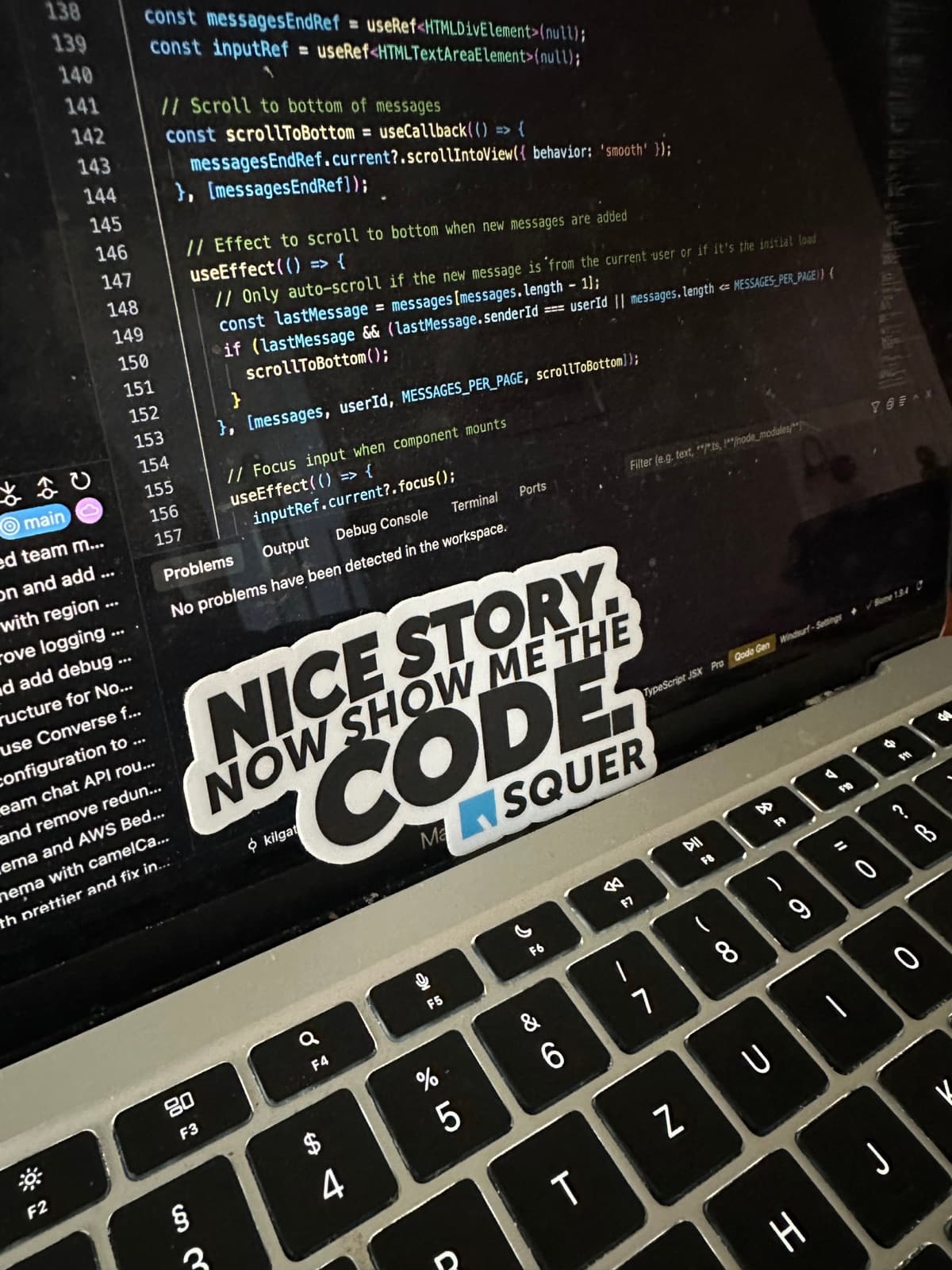
On my laptop there's a sticker: "Nice story, now show me the code." I picked it up at a SQUER event, and it has been staring at me through every meeting since. The phrase descends from Linus Torvalds' old challenge (talk is cheap, show me the code), and inside software teams it was always a bit of an inside joke. It doesn't feel like a joke anymore. It feels like the exact discipline the GenAI era is quietly dissolving.
Here's the problem in one sentence: generative AI has made plausible output free, and plausible output is not the same thing as correct work.
Ask a chatbot for a marketing plan, a Python function, a strategy outline: you'll get something coherent in seconds. Coherent is the trap. When the answer arrives polished, the pressure to check it evaporates. And we now have measurements of what that does to us. In a Microsoft/Carnegie Mellon study of knowledge workers, people reported applying no critical thinking at all to 40% of the tasks they completed with generative AI. The same research found the correlation you'd fear: the more people trusted the AI, the less they scrutinized its output. Not because they became stupid: because the output sounded done.
You can watch the same shift in public data. Stack Overflow (the place where programmers argued, corrected each other, and left a searchable trail of why the accepted answer was accepted) has seen new questions collapse by more than 70% since ChatGPT launched. The quick fix now comes from a model instead of a peer. Sometimes the fix is right. But the argument in the comments, the "careful, this breaks on empty input," the accumulated reasoning: that part is gone. We're trading understanding for throughput and mostly not noticing, because throughput is what shows up in the demo.
I see the consequences in my own field constantly. A junior developer ships code they can't explain. A strategy deck survives exactly zero rounds of basic questioning because the AI that wrote it leaned on the same conventional wisdom it was trained on. A summary cites papers that don't exist. Each individual artifact looks fine at a glance. The glance is the vulnerability.
None of this is an argument against the tools. I use them daily, aggressively, for exactly what they're good at: first drafts, boilerplate, exploration, summarization. The argument is about what happens after the model answers. Three habits, none of them complicated:
Treat AI output as a hypothesis, not a result. Run the code against edge cases. Check the citation exists. Ask where the data behind the confident claim comes from. If a colleague handed you this work, you'd review it; the standard doesn't drop because the colleague is a model that never gets embarrassed.
Demand the reasoning, not just the artifact. In code review the question is "walk me through it." Make that question standard for AI-assisted work of every kind: strategy documents, designs, analyses. If the honest answer is "I took what the model gave me," the work isn't done yet. This isn't about shaming AI use; it's about keeping a human who understands the thing in the loop, because that human is who the organization is actually paying for.
Keep lifting without the machine sometimes. Debug something by hand. Write the argument before asking the model for one. The Microsoft/CMU researchers warn that automating routine judgment removes the practice reps that keep judgment sharp: "atrophied and unprepared" is their phrase for where the muscles end up. You don't need to be a purist. You need to stay strong enough to catch the model when it's wrong, because catching it is now the job.
That last point is the real career advice hiding in all of this. When everyone has the same magic first-draft machine, the first draft is worth approximately nothing. The value moved: it now lives in what you do beyond the draft, the error you catch, the assumption you challenge, the context only you have. The people who thrive with these tools won't be the ones who prompt fastest. They'll be the ones who kept their skepticism in working order while everyone else outsourced theirs.
So keep the sticker's question loaded, for the model and for yourself: nice story, now show me the code.
Further Reading
- Microsoft / Carnegie Mellon: The Impact of Generative AI on Critical Thinking: the 40% figure, and the trust-vs-scrutiny correlation.
- Big Think: Is AI eroding our critical thinking?: why the outcome isn't inevitable if AI is used as a tool for thought, not a replacement.
- Science Daily: Generative AI boosts individual creativity while narrowing collective diversity: better individual output, more similar output overall.